One Database, One Policy: Why This Mindset Is Quietly Killing Startups
Introduction
Walk into almost any early-stage startup's tech stack today and you'll find the same story: a single MongoDB or Firebase instance holding everything — user accounts, orders, chat logs, analytics events, session tokens, notifications, the works. NoSQL databases made this easy. No rigid schema, no upfront modeling, no DBA required — just point your app at a connection string and start writing documents.
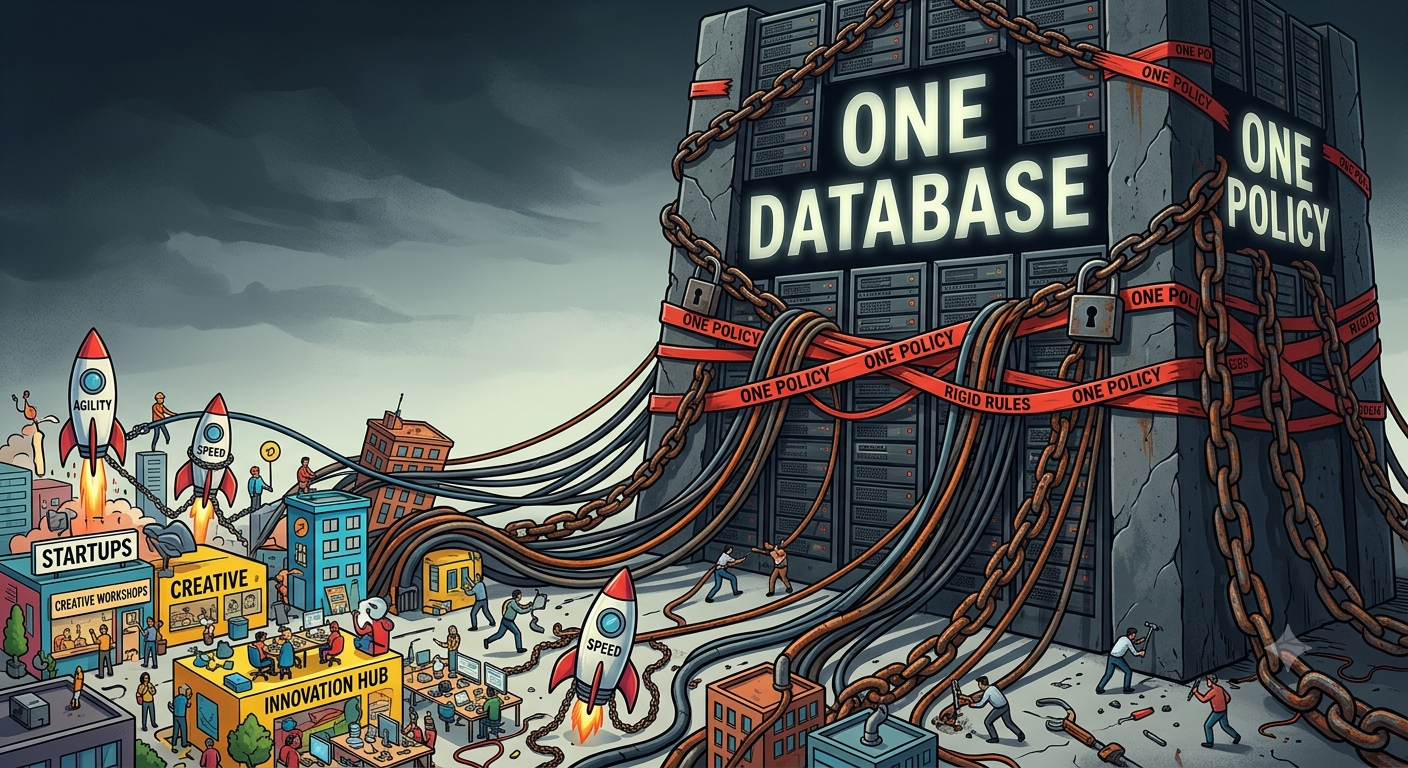
That ease is exactly the trap. The same flexibility that lets a two-person team ship a product in a weekend is what causes that product's database to buckle the moment real traffic shows up. This article looks at why the "one database, one policy" approach — a single database instance serving every part of an application with no differentiation in how data is handled, load-balanced, or cached — is one of the most common and least discussed reasons startups fail at the infrastructure level, long before the business reasons even get a chance to matter.
The Rise of NoSQL and the "Just Use One DB" Habit
MongoDB, Firebase Realtime Database, Firestore, and similar document/JSON-style stores became popular because they remove friction:
No schema migrations to plan before shipping a feature
Data shaped like the JSON your frontend already sends
Managed hosting (Atlas, Firebase) that hides operational complexity
Free tiers that make early-stage cost basically zero
The result is a generation of engineers who reach for "the database" as a single, undifferentiated bucket. Every feature — user profiles, product catalog, chat, notifications, audit logs, analytics — writes to the same cluster, often the same collection namespace, under the same connection pool, with the same read/write policy applied uniformly regardless of what the data actually needs.
This works fine at 100 users. It works fine at a demo. It works fine right up until it doesn't — and by the time it doesn't, the failure is rarely graceful.
Why the Server Actually Crashes
"One DB, one policy" doesn't fail because NoSQL is bad technology. It fails because of what gets skipped when everything shares one database with no differentiated handling:
No isolation between workloads. A heavy analytics query or a bulk export job runs on the same cluster serving live user logins. When that report query locks up resources, login requests queue behind it, and eventually the whole app looks "down" — even though the actual outage is one bad query.
No connection pool discipline. Every service, every serverless function, every background worker opens its own connections to the same database. NoSQL drivers are forgiving about this, so nobody notices until concurrent connections hit the plan's ceiling and new connections start getting refused — which looks exactly like a crash from the outside.
Uniform read/write policy regardless of access pattern. A chat feature that needs low-latency writes and eventual consistency gets the same write concern and read preference as a payment record that needs strong consistency. Either the chat feature is unnecessarily slow, or the payment data is unnecessarily loose — and teams usually pick "fast" for everything, which is fine until it silently corrupts something that mattered.
No circuit breaker between the database and its consumers. When the single database's response time creeps up under load, every service that depends on it slows down together, since there is no boundary that isolates a struggling subsystem from a healthy one. One slow collection can drag down an entire product.
Nothing sits in front of the database to absorb repeat traffic. Every read, including identical reads served a thousand times a minute, goes all the way to disk. There is no caching layer catching the requests that don't need to reach the database at all, so the database ends up doing far more work than the actual unique-data requirements justify.
None of these are NoSQL problems. They are architecture problems that "one DB, one policy" makes almost inevitable, because the whole premise is: don't differentiate, just point everything at the same place.
Why This Specifically Kills Startups
Larger companies survive this pattern because they eventually have the headcount to notice and fix it before it becomes existential. Startups usually don't get that runway, for a few reasons:
The crash arrives exactly when it's most expensive. It's rarely random load — it's a launch day, a press mention, a demo to an investor, or the first real customer cohort hitting the product at once. The one moment the database needed to hold is the moment "one policy for everything" gives out.
Nobody owns the database as a discipline. In a five-person team, the database is "whoever wrote that endpoint's" concern. There is no one whose job is to ask what the read/write pattern per feature actually requires, so no differentiation ever gets introduced — the app just keeps growing on top of the same undifferentiated bucket.
The fix looks like a rewrite, so it keeps getting postponed. By the time the pain is visible, splitting the data, adding caching, and introducing load balancing feels like a multi-week project competing with feature work — and feature work usually wins, until the outage forces the issue anyway, at a worse time and under more pressure.
Trust, once lost, is hard to recover for an early-stage product. A slow or down app during a startup's first wave of real users often costs more in churned trust than the technical fix would have cost in engineering time.
The pattern, put simply: startups don't usually fail because they picked MongoDB or Firebase. They fail because they never asked what different parts of their data actually needed, and treated the whole application as if it had one uniform data-access pattern.
Department-Wise / Service-Wise Database Handling
The alternative to "one DB, one policy" is not necessarily "many databases from day one" — it's treating data access by domain, the way different departments in a company handle their own records differently, rather than one shared filing cabinet for the entire org.
In practice this means:
Separate data stores (or at least separate clusters/instances) by bounded context. User authentication and session data, transactional/order data, content and catalog data, chat/messaging data, and analytics/logging data each have different consistency, latency, and durability requirements — they shouldn't compete for the same connection pool or the same disk I/O.
Different consistency guarantees per domain. Payment and inventory data usually need strong consistency and transactional guarantees; a chat message feed or a "last seen" timestamp can tolerate eventual consistency in exchange for speed.
Different backup and retention policies per domain. Financial and audit data typically needs longer retention and stricter backup cadence than ephemeral session or cache data — bundling them under one policy means either over-retaining everything (cost) or under-retaining the data that legally or operationally needs it.
Independent scaling per domain. Analytics writes can spike heavily without needing to affect the responsiveness of the login flow, if they're not sharing the same cluster.
This is the same idea behind the "database per service" pattern in microservice architecture, and it doesn't require microservices to start applying it — even a monolith benefits from routing different data domains to differently-configured connections, indexes, and (eventually) separate instances.
Load Balancing Methods for Databases
Load balancing at the database layer is a distinct problem from load balancing at the web-server layer, and it's the piece most commonly skipped entirely in early-stage builds:
Read replicas with read/write splitting. Writes go to a primary node; reads are distributed across one or more replicas. This is the single highest-leverage change for read-heavy apps (which most consumer and SaaS products are).
Sharding / horizontal partitioning. Data is split across multiple nodes by a shard key (e.g., user ID range, tenant ID, geographic region), so no single node holds — or has to serve — the entire dataset. MongoDB supports this natively; Firebase/Firestore requires this to be designed manually via collection partitioning.
Connection pooling and proxying. Tools like PgBouncer (Postgres), ProxySQL (MySQL), or MongoDB's own driver-level pooling sit between the application and the database, multiplexing many client connections into a smaller, controlled number of actual database connections — preventing connection exhaustion under load spikes.
Geographic/multi-region distribution. For global user bases, replicating data closer to users (and routing reads to the nearest replica) reduces latency and spreads load rather than funneling every request to one region.
Rate limiting and request queuing in front of the database. Not glamorous, but effective: capping how many requests per second reach the database, with graceful queuing or backpressure, keeps a traffic spike from turning into a full outage.
Caching Methods That Prevent the Database From Ever Feeling the Load
Caching is the other half of the fix, and it compounds well with load balancing — every request served from cache is a request the load balancer never had to route at all:
Cache-aside (lazy loading). The application checks the cache first; on a miss, it reads from the database and populates the cache for next time. Simple and the most common pattern with Redis or Memcached in front of MongoDB/Firebase.
Write-through caching. Writes go to the cache and the database together, keeping the cache always current at the cost of slightly slower writes — useful for data read far more often than it's written (product catalogs, user profiles).
Write-behind (write-back) caching. Writes land in the cache first and are flushed to the database asynchronously in batches — higher throughput, but requires care around durability guarantees.
CDN-level caching for public, rarely-changing data. API responses that don't depend on the individual user (public content, static configuration) can be cached at the CDN edge, never touching the application server or database at all.
In-memory application-level caching. For very hot, small datasets (feature flags, config, rate-limit counters), an in-process cache avoids even a network hop to Redis.
Query result caching with sensible TTLs and explicit invalidation. The failure mode to avoid is stale data lingering past its usefulness — caching without a clear invalidation strategy just relocates the bug rather than fixing it.
Bringing It Together
None of this requires an early-stage team to over-engineer before they have users. The point isn't "build for a million users on day one" — it's the opposite: know which parts of your data need different treatment, and don't let the convenience of a single NoSQL cluster talk you into pretending all your data is the same.
A practical starting checklist for a startup's database layer:
Identify your 3–5 core data domains (auth, transactional, content, messaging, analytics) and note which need strong consistency versus which can be eventual.
Put at least one read replica in front of any collection or table that gets read far more than it's written.
Add a caching layer (Redis is the standard default) for anything read repeatedly with the same result.
Use a connection pooler/proxy rather than letting every service or function open its own raw connections.
Set differentiated backup and retention policies per domain instead of one blanket policy for the whole database.
Load-test the specific access patterns you expect at your next milestone (launch, campaign, funding announcement) before you hit them for real.
The startups that survive their first real traffic spike aren't the ones with the fanciest architecture — they're the ones that stopped treating "the database" as one undifferentiated thing early enough to matter.
About the author
Hi I am Kasinadhsarma
Comments
Join the discussionThe point about workload contention hitting right during launch day is painfully accurate. Running heavy analytics queries or background jobs on the same cluster serving live user logins is a silent killer. Even within a monolith, introducing basic connection pool discipline, read replicas, and a caching layer before your first traffic spike is the difference between surviving a launch and taking down your entire app.
Good call — that's exactly right, and worth calling out. I didn't want people to read "split by domain" and think none of this helps until they do a full rearchitecture. Pooling, a read replica, and caching are honestly the easiest wins precisely because they bolt onto a monolith with zero architecture changes — a couple days of work that can save you on launch day, way before you're ready for the bigger split.